




















Hotel Revenue Management: A Practical Guide for UK Hoteliers
Share this post

Hotel revenue management is the process of using booking data, demand forecasts and market information to manage room rates, availability and distribution. It helps hotels decide what to sell, at which price and through which channels, while considering acquisition costs and opportunities to earn additional revenue from each stay.
For an independent UK hotel, that means making practical decisions: when to increase rates for an event weekend, how to attract midweek bookings, which channels justify their costs and when to offer a room upgrade. The starting point is understanding your own booking patterns.
Why is revenue management important for hotels?
A room night cannot be sold after its date has passed. However, filling every room at a heavily discounted rate can also leave revenue behind. Revenue management helps you balance the number of rooms sold with the rate achieved and the cost of securing those bookings.
A 40-room hotel selling 30 rooms at an average rate of £150 generates £4,500 in room revenue. Its occupancy is 75% and its revenue per available room, or RevPAR, is £112.50.
Selling 36 rooms at £120 raises occupancy to 90%, but generates £4,320 and a RevPAR of £108. Higher occupancy has produced less room revenue. These simplified figures exclude taxes, ancillary revenue and costs.
The commercial goal is to improve the value of your available capacity. Room revenue, distribution costs, additional guest spending and operating costs all contribute to that assessment.
How to build a hotel revenue management strategy in five steps
- Establish your starting position. Review room revenue, occupancy, average daily rate, cancellations and channel performance. Separate results by stay date, room type and day of the week.
- Understand your guest segments. Compare business, leisure, group and other relevant demand. Look at booking lead time, length of stay, cancellation behaviour and spending on extras.
- Forecast demand. Combine reservations already booked with expected additional bookings and cancellations. Add local events, bank holidays and relevant school holiday periods to your demand calendar.
- Set rates and availability rules. Decide which room categories, rate plans, offers and stay restrictions suit each date. Coordinate changes across your direct and third-party channels.
- Measure and adjust. Compare actual performance with your forecast. Record what changed, why you changed it and whether the result supports repeating that decision.
Compare like with like. A Saturday during a major local event is a better reference for a similar event night than for an ordinary weekday. When comparing advance bookings with last year, use the same number of days before arrival.
Practical hotel revenue management strategies
1. Adjust pricing by demand and room category
Review how quickly each room category is selling. If family rooms are booking strongly for a school holiday while doubles remain available, assess the price difference between those categories instead of increasing every rate equally.
For a quieter date, investigate booking pace, visibility and restrictions before discounting. A poorly configured minimum stay or an unavailable rate plan can prevent bookings even when the price is reasonable. Explore our guide to hotel dynamic pricing for a closer look at rate adjustments.
2. Use stay restrictions selectively
A minimum stay can help connect a busy Saturday with a quieter Friday or Sunday. It can also exclude guests who would otherwise book. Apply restrictions to dates with a clear commercial reason and review them as arrival approaches.
For group enquiries, consider the rooms and dates the group would occupy, its expected total spending and the individual bookings you might have to turn away. A large booking is valuable only when its overall contribution makes sense.
3. Compare channels after acquisition costs
Build a distribution mix around the guests you need to reach. OTAs can introduce new demand, while your hotel booking engine gives guests a direct route to reserve. There is no universal ideal number of channels or direct-booking percentage.
Compare commission, payment processing, advertising, discounts and cancellation patterns. Direct bookings also have acquisition costs, so assess the amount retained from each channel rather than the headline room rate alone.
On the same revenue basis, a £150 booking with an assumed 15% commission leaves £127.50 before other costs. A £145 direct booking with £8 in attributable acquisition and processing costs leaves £137.
These are example assumptions, not standard commission rates or profit figures. Use your own agreements and cost data.
4. Offer useful upgrades and extras
Upselling moves a guest to a higher-value option, such as a larger room. Cross-selling adds a complementary service, such as breakfast, parking or dinner. Make the offer relevant to the stay and explain the price clearly.
Check availability and delivery costs before promoting early check-in, late check-out or packages. An upgrade also changes which room categories remain available to sell. With RaccoonUpsell, guests can select eligible room upgrades and extras during online check-in.
5. Evaluate revenue from other spaces
Meeting rooms, parking spaces and workspaces can generate income beyond accommodation. Compare the additional revenue with staffing, cleaning and service costs, and consider whether the activity affects overnight guests.
“By identifying underutilised areas in your hotel, you can unlock new revenue streams through better space management.”
— Kristine, RoomRaccoon
For internal space comparisons, RevPAM measures revenue per available square metre over a defined period. For example, £3,000 generated by a 150 m² meeting room in one week equals £20 per m² for that week. This measures revenue density; costs must be assessed separately.
6. Put competitor rates in context
Choose a competitive set of properties with comparable locations, facilities, room categories and target guests. Compare equivalent offers, including breakfast and cancellation terms.
A competitor appearing sold out on one booking channel does not prove that its entire hotel is full. Use rate-shopping information alongside your own booking pace and availability. Your reviews and service quality also influence whether guests see your rate as good value: address recurring feedback and keep listings accurate.
7. Match payment terms to your rate plans
A flexible rate and a lower non-refundable rate serve different booking needs. Set a deliberate price difference and make payment and cancellation conditions clear before booking.
Advance payments can improve cash flow, but receiving money earlier does not by itself increase the value of a stay. Monitor cancellations, refunds and outstanding balances alongside reservation revenue.

Which hotel revenue management metrics should you track?
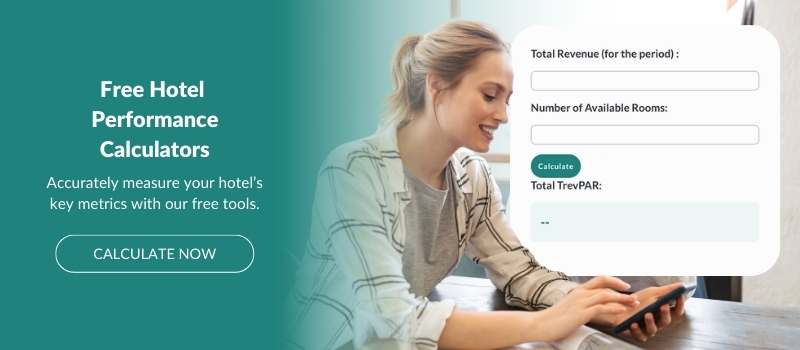
Start with occupancy, ADR and RevPAR, then add total revenue and operating profit to understand the wider business. Calculate every metric for the same period and use consistent definitions for revenue, taxes and available inventory.
| Metric | Formula | What it tells you |
|---|---|---|
| Occupancy | Room nights sold ÷ room nights available × 100 | The percentage of available room nights sold. |
| ADR: average daily rate | Room revenue ÷ room nights sold | The average room revenue earned per room night sold. |
| RevPAR: revenue per available room | Room revenue ÷ room nights available | Room revenue performance across both sold and unsold capacity. |
| TRevPAR: total revenue per available room | Total operating revenue ÷ room nights available | Revenue from rooms and other operating departments relative to room capacity. |
| GOPPAR: gross operating profit per available room | Gross operating profit ÷ room nights available | Operating profitability relative to available room capacity. |
| RevPAM: revenue per available square metre | Revenue from the measured space ÷ its available area in m² | Revenue generated per square metre over a specified period. |
Scroll horizontally on smaller screens. For a multi-night period, use room nights: 40 available rooms over seven nights provide 280 available room nights.
You can also calculate RevPAR as ADR multiplied by occupancy expressed as a decimal. For example, £150 × 0.75 = £112.50. Neither RevPAR nor TRevPAR measures profit, because neither deducts operating costs.

Alongside these results, track booking pickup: the change in reservations or room nights on the books between two reporting dates for a defined stay period. Specify whether your report shows gross new bookings or net pickup after cancellations and amendments.
What should you review daily and weekly?
A short, consistent routine makes revenue management manageable for a small team. Assign an owner and record significant changes so colleagues understand the current plan.
- Daily: check new bookings, cancellations, near-term pickup, remaining room categories and unusual rate or availability changes. Review pricing recommendations and confirm that intended changes reach connected channels.
- Weekly: review the coming weeks and months by stay date. Compare booking pace with your forecast, revisit event dates and assess channel costs, offers and stay restrictions.
- Monthly: compare actual revenue and operating profit with your targets. Review which segments, channels and extras contributed most, and update your assumptions.
If a future Saturday is filling faster than expected but Sunday remains weak, review the two dates separately. Consider the remaining room types and expected demand before applying a blanket weekend discount.
How does RoomRaccoon support hotel revenue management?
RoomRaccoon connects reservation management with distribution, direct bookings and reporting. Its revenue tools support different levels of pricing automation:
- RaccoonRev and dynamic pricing rules: combine competitor rate shopping with rules based on conditions such as occupancy, days before arrival and competitor activity.
- RaccoonRev Plus: adds AI-supported rate recommendations using property and market signals. The current product supports recommendations up to 365 days ahead, with manual review or autopilot.
- Channel manager: distributes rates and availability to connected booking channels.
- Hotel reporting: helps your team review booking, revenue and operational performance.
For a UK example, read the L’Enclume case study, which describes its use of dynamic pricing, direct bookings and automated upselling.
Confirm which tools and reports are included in your proposed package. If you are comparing providers or considering a separate RMS, use our guide to hotel revenue management systems to assess the available approaches.
Hotel revenue management FAQs
What is the difference between revenue management and yield management?
Hotel yield management usually focuses on pricing and selling a limited inventory of room nights. Revenue management has a broader scope, including forecasting, guest segments, distribution costs and revenue from other services. Yield management is one part of that wider strategy.
Can a small hotel manage revenue without a dedicated revenue manager?
Yes. Start with reliable reservation data, a demand calendar, a small set of metrics and a scheduled review. An owner or manager can oversee the process, supported by pricing tools. Assign clear responsibility for rate changes and exceptions.
Should you lower room rates when occupancy is low?
First consider how far away the stay date is and whether bookings are behind the normal pace for that date. Check visibility, availability settings, restrictions and competing offers. A targeted offer may be appropriate, but low advance occupancy alone is not enough to justify a discount.
What is a good RevPAR for a UK hotel?
There is no single useful benchmark for every UK hotel. Location, property type, season and service level all affect performance. Compare your RevPAR with comparable periods and a relevant competitive set, then assess distribution costs and operating profit separately.
Does revenue management software guarantee higher revenue?
No. Results depend on demand, data quality, configuration, your commercial decisions and the guest experience. Software can process information and apply changes more efficiently, but your team still needs to review performance and manage unusual situations.
See how your revenue strategy could work in RoomRaccoon
Bring your room categories, current rate plans and a quiet or high-demand period to a personalised demo. Explore how pricing rules, AI recommendations, distribution and reporting could support your hotel’s daily decisions.
Follow us


Nicky. M
Nicky is RoomRaccoon's Senior Content Manager, combining a love for travel with a practical approach to improving hotel performance through tech and insightful tips. Join her journey where travel, hospitality, and technology meet.



Subscribe to our newsletter for more on the latest hospitality & RoomRaccoon updates delivered straight to your inbox!


