
















How UK Hotels Can Increase Direct Bookings: 20 Practical Strategies for 2026
Share this post

UK hotels can increase direct bookings by combining a fast, mobile-friendly booking engine with a clear book-direct proposition, accurate rates on Google, secure payments and a strategy for bringing previous guests back. The goal is not to eliminate online travel agencies (OTAs), but to build a profitable channel mix in which direct bookings contribute more net revenue and stronger guest relationships.
Key takeaways
- A direct booking avoids OTA commission, but it can still involve website, advertising, payment-processing and technology costs.
- RoomRaccoon data shows that direct bookings became the largest booking channel for UK independent hotels in summer 2025.
- The strongest direct-booking strategies improve visibility, booking-engine conversion, rate transparency and repeat demand together.
- UK hotels must also account for price-transparency rules, UK GDPR and the Privacy and Electronic Communications Regulations (PECR).
Contents
- What is a direct hotel booking?
- Direct bookings in the UK
- Direct bookings vs OTA bookings
- Build a direct-booking foundation
- Win more direct-booking traffic
- Improve direct-booking conversion
- Build repeat demand and measure performance
- UK hotel case study
- Frequently asked questions
What is a direct hotel booking?
A direct hotel booking is a reservation made with the property without an OTA or traditional travel agent completing the transaction. Guests may book through the hotel website and booking engine, by phone or email, through a direct social-media booking link, or at the front desk.
The booking channel and the acquisition source are not always the same. A guest might click a paid Google Hotel Ad but complete the reservation through the hotel’s own booking engine. That is a direct booking with a paid acquisition cost. Distinguishing between the two helps hotels compare channel profitability accurately.
A connected technology stack makes direct reservations easier to manage. The hotel reservation software, property management system (PMS), booking engine, channel manager and payment system should share rates, availability, booking details and guest information without manual re-entry.
Are direct hotel bookings growing in the UK?
Yes. RoomRaccoon’s UK Hotel Performance Report for summer 2025 analysed more than 600,000 bookings from 2,000 independent hotels across the UK, the Netherlands, Belgium, Germany, Spain and Portugal.
This does not mean UK hotels should abandon OTAs. It shows that independent properties can build a strong direct channel when their website, rates, booking journey and guest-retention strategy work together.
What is the difference between direct and OTA bookings?
Direct bookings and OTA bookings play different roles. Direct channels usually provide more control and a closer guest relationship, while OTAs can introduce a property to travellers who would not otherwise discover it.
| Comparison | Direct bookings | OTA bookings |
|---|---|---|
| Booking path | Hotel website, booking engine, phone, email or front desk | Third-party platform such as Booking.com or Expedia |
| Acquisition cost | No OTA commission, but marketing, technology and payment costs may apply | Commission and optional programme or promotional costs vary by contract |
| Guest data | Direct access to the data collected during booking, subject to UK GDPR and PECR | Access may be restricted by the platform and its terms |
| Brand and upselling | Hotel controls the booking journey, content, packages and add-ons | Hotel works within the OTA’s layout, merchandising and communication options |
| Reach | Depends on the hotel’s brand, search visibility, partnerships and marketing | Provides access to an established international audience |
| Rates and policies | Hotel controls its direct rate plans and book-direct benefits | Displayed according to the OTA agreement and platform rules |
| Best strategic role | Profitability, loyalty, repeat stays and brand control | Discovery, market reach and incremental demand |
Direct does not automatically mean more profitable. A booking generated through expensive advertising can cost more to acquire than expected. Compare net revenue, cancellation behaviour and lifetime value rather than looking only at commission or direct-booking share.
Related: Work with OTAs, not for them – regain control of payments and revenue
How should hotels balance direct bookings and OTAs?
A healthy hotel distribution strategy uses each channel for a defined purpose. OTAs can generate visibility and first-time demand, metasearch can show the hotel’s direct rate beside third-party rates, and the hotel website can convert informed travellers and previous guests.
A hotel channel manager keeps rates and availability synchronised across the booking engine and connected channels. This reduces manual work and helps prevent overbookings while the hotel adjusts its channel mix by season, market and demand level.
In this episode of Diary of a Hotelier, RoomRaccoon CPO Nadja Buckenberger explains how The Bliss developed a booking-channel mix in which direct reservations represented half of all bookings.
Build a direct-booking foundation
1. Use a commission-free hotel booking engine
A mobile-friendly hotel booking engine is the foundation of an online direct-booking strategy. It should show live availability and rates, provide clear room and policy information, accept secure payments and send confirmed reservations directly to the PMS.
A commission-free booking engine removes a per-reservation booking-engine commission. It does not remove payment-processing, website or marketing costs, so these should still be included when calculating the cost of a direct booking.
Important conversion features include:
- real-time rates and availability;
- a short, mobile-friendly booking flow;
- promo codes, rate plans and bookable extras;
- clear taxes, mandatory charges and cancellation terms;
- multi-language and currency options where relevant;
- secure payment processing;
- analytics and campaign tracking.
For a fuller feature checklist, read the complete hotel booking engine guide.
2. Make your hotel website easy to book
A polished website does not generate bookings if visitors struggle to find rooms, understand the total price or complete checkout. Treat every important page as part of the booking journey.
- Use clear booking buttons: Place a visible “Book now” action on the homepage, room pages, package pages and high-traffic destination content.
- Link to the relevant booking step: A room-page button should open the correct room or date selection rather than sending users back to a generic homepage.
- Design mobile-first: Test navigation, date selection, forms, rate comparisons and payment on an actual phone.
- Reduce friction: Remove unnecessary fields and explain policies before the payment stage.
- Protect performance: Compress images, avoid intrusive pop-ups and monitor Core Web Vitals.
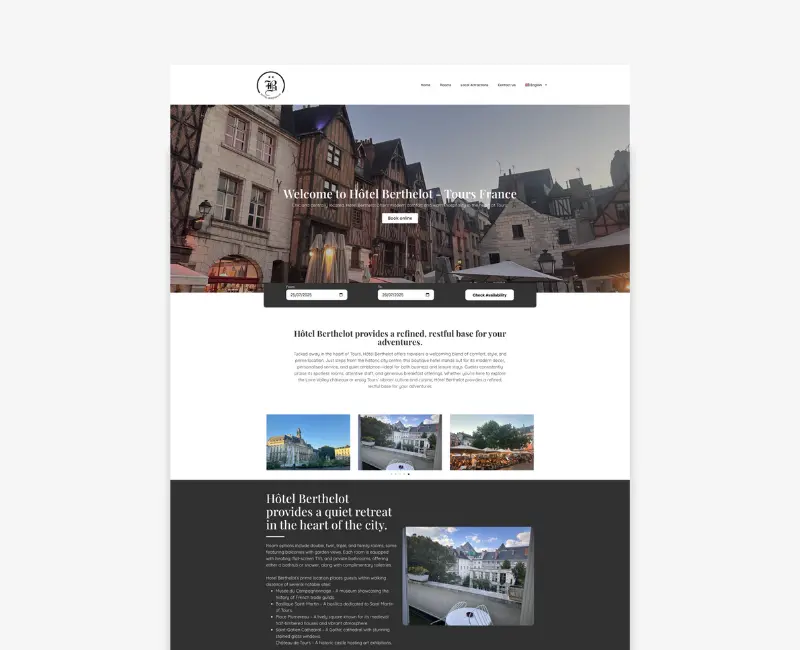
If a hotel needs a new conversion-focused site, an integrated hotel website builder can connect the content, booking engine and tracking more closely.
3. Offer secure and convenient payment options
Guests compare a hotel’s checkout experience with the smooth payment flow they receive from major booking platforms. An integrated hotel payment system should make payment straightforward without weakening security.
- Display prices in pounds sterling for UK guests and localise currency where appropriate for international visitors.
- Support familiar card types and digital wallets when available.
- Use tokenisation rather than storing raw card details.
- Apply 3D Secure and Strong Customer Authentication where required.
- Explain deposits, payment schedules, pre-authorisations and refunds before confirmation.
- Make the payment screen easy to use on mobile devices.
Connecting payments to the PMS also reduces manual reconciliation and makes it easier to send secure payment requests for phone, email and group enquiries.
4. Support multi-room and group bookings
Standard booking flows often work well for one room but create friction for families, wedding parties, retreats and corporate groups. Hotels that regularly serve these guests should offer a direct route for more complex requests.
- Allow several rooms to be booked in one transaction.
- Support different occupancy, arrival or departure details by room.
- Provide space for accessibility and room-proximity requests.
- Create room allotments with private booking links.
- Offer negotiated rates through booker codes or secure access.
- Use automated proposals when an instant online booking is not appropriate.
Learn more about using room allotments to manage hotel group bookings.
Win more direct-booking traffic
5. Strengthen local search visibility
Travellers often search by destination, neighbourhood, property name or a nearby landmark before choosing where to book. A complete and accurate Google Business Profile supports this discovery process.
- Keep the hotel name, address, telephone number and website consistent.
- Select the correct primary and secondary categories.
- Maintain current check-in times, amenities, accessibility details and photographs.
- Respond constructively to genuine guest reviews.
- Check that the website and booking link point to the hotel’s official pages.
The hotel website should also contain useful destination information, not just generic copy. Create pages about nearby attractions, seasonal events, transport, parking and the types of stay the property serves.
6. Use Google Hotels and free booking links
Google Hotels can display a hotel’s direct rate beside rates from OTAs when the property supplies accurate availability, pricing and a valid booking-page URL. This gives high-intent travellers a direct route to the hotel’s own booking engine.
It is important to distinguish between:
- Free booking links: Unpaid links ranked using signals such as value, landing-page experience and price accuracy.
- Google Hotel Ads: Paid placements that can provide additional visibility.
Google ended self-service hotel rates on 30 July 2025. Hotels now generally need a central reservation system, internet booking engine or approved integration partner to send rates and availability to Google. RoomRaccoon’s Google Hotels integration connects the booking engine with this ecosystem.
Price accuracy matters for both free and paid links. The total bookable price on the hotel website should match the price sent to Google, including mandatory taxes and charges. Consult Google’s hotel price accuracy policy and RoomRaccoon’s Google Hotel Ads guide for more detail.
7. Publish useful destination and hotel content
Search content can introduce the property before a traveller reaches an OTA. Focus on topics that help a potential guest plan a real stay, such as:
- where to stay for a particular attraction or event;
- family, pet-friendly, accessible or business-travel facilities;
- transport links, parking and EV charging;
- seasonal packages and local experiences;
- room comparisons and answers to common pre-booking questions.
Connect relevant articles to room, package and booking pages with descriptive internal links. A broader hotel marketing strategy should combine this organic visibility with metasearch, email, partnerships and paid media.
8. Promote the booking engine through owned channels
Do not make interested guests search for the booking page. Add a direct booking-engine link to social-media profiles, campaign landing pages and relevant email communications.
- Use real guest experiences and property footage rather than only promotional graphics.
- Link packages and seasonal campaigns to the matching booking dates or rate plan.
- Tag campaign links with UTM parameters.
- Keep the promise in the post, advert or email consistent with the landing page.
- Test the complete journey inside mobile social-media browsers.
Social media can create interest, but the booking engine still needs to convert that interest into a confirmed reservation.
Improve direct-booking conversion and value
9. Give guests a clear reason to book direct
Travellers may discover the hotel through an OTA and then visit the official website. Make the direct-booking benefit visible before they return to the comparison platform.
Useful incentives include:
- a best-rate or best-value promise that the hotel can honour;
- flexible cancellation or payment terms;
- breakfast, parking or welcome amenities;
- early check-in or late check-out, subject to availability;
- a room upgrade or property credit;
- access to packages not listed on OTAs.
A benefit does not always need to be a percentage discount. An experience-led extra can protect the room rate while making the direct offer more valuable.

10. Show a transparent total price and direct-booking value
A price-comparison widget can show the hotel’s Best Available Rate (BAR) beside selected OTA rates. Check it regularly: an inaccurate comparison damages trust and may conflict with the hotel’s distribution agreements.
UK price-transparency rules are especially important. Since 6 April 2025, mandatory charges must be included in the headline total price rather than being introduced later in checkout. Optional extras may remain separate, but they should be presented clearly and not preselected deceptively.
Hotels should also review any contractual hotel rate parity requirements. When a lower public direct rate is not appropriate, compete through added value, flexible terms or a closed returning-guest offer.
11. Offer rate plans for different booking preferences
Guests do not all value the same thing. A small, clearly explained set of rate plans can capture different needs without making the booking engine confusing.
- Flexible rate: Suits guests who value cancellation flexibility.
- Non-refundable rate: Exchanges flexibility for a defined saving or benefit.
- Advance-purchase rate: Encourages earlier commitment and supports forecasting.
- Package rate: Combines the room with breakfast, dining, spa access, parking or a local experience.
- Returning-guest or corporate rate: Uses a secure code or login for an eligible audience.
Display the total price, payment timing, inclusions and cancellation terms in a format guests can compare quickly.
12. Use demand-based pricing

Flat rates can leave revenue on the table during high demand and make the property less competitive during quieter periods. Demand-based pricing adjusts rates using signals such as booking pace, remaining availability, lead time, competitor positioning and local events.
Tools such as RaccoonRev Plus can generate pricing recommendations from market and property data. The hotel should still define its commercial rules, review unusual recommendations and keep public pricing transparent.
Connect the pricing process to hotel revenue management software so approved rate changes reach the booking engine and distribution channels consistently.
13. Use photographs and room information that answer questions
Guests cannot inspect a room before booking, so photographs and descriptions need to reduce uncertainty. Show each room type from several useful angles and include the bathroom, view, workspace, storage, accessibility features and any meaningful differences between categories.
- Use recent, high-resolution photographs of the actual property.
- Keep editing natural enough to set realistic expectations.
- Add concise captions and descriptive alt text.
- Optimise file size without making the images visibly soft.
- Use video or a 360-degree virtual tour when it adds information.
Make sure room names, bed configurations, occupancy and amenities are consistent across the website, booking engine and major listings.
14. Answer booking questions before guests leave
Live chat and hotel guest-messaging tools can answer common questions about parking, arrival times, room facilities, accessibility and policies while the guest is deciding whether to book.
Automation works best when:
- answers use current property information;
- the system links to the relevant room, package or booking step;
- complex or sensitive questions reach a member of staff;
- conversations and consent are handled in line with privacy requirements;
- the hotel reviews unanswered questions to improve its website content.
Compare suitable platforms in RoomRaccoon’s guide to the best hotel guest-messaging apps.
15. Make the property distinctive and verifiable in AI-assisted search
Travellers increasingly use AI-assisted search to compare destinations and properties. Hotels improve their chances of being represented accurately by publishing specific, consistent and up-to-date information that can be verified across trusted sources.
- Explain exactly where the property is and what is nearby.
- Document distinctive rooms, amenities, experiences and policies.
- Keep check-in times, parking, pet, family and accessibility information current.
- Use first-party photographs and original local expertise.
- Align important facts across the hotel website, Google Business Profile, tourism listings and OTAs.
- Make core content and booking links crawlable and understandable without relying on vague marketing claims.
There is no special schema or writing trick that guarantees inclusion in an AI answer. Google’s guidance for generative search confirms that clear technical SEO, useful first-party content and consistent real-world information remain the foundation.
Build repeat direct demand and measure performance
16. Turn a successful OTA stay into a future direct relationship
An OTA can introduce a guest to the property. The hotel experience can then give that guest a reason to return directly next time.
- Provide excellent service and explain the benefits available to returning guests.
- Invite guests to join an email list or loyalty programme through an owned and compliant touchpoint.
- Use post-stay communication to request feedback and, where permitted, present a future direct-booking benefit.
- Make the official website easy to recognise and find.
A booking confirmation or operational message is not automatically permission to send marketing. The Information Commissioner’s Office confirms that an email promoting a future hotel offer is direct marketing. Hotels should use an appropriate route under UK GDPR and PECR, provide a clear opt-out and comply with the OTA’s terms. See RoomRaccoon’s guide to email marketing for hotels.
17. Build loyalty and referrals around useful benefits
A loyalty programme does not need a complex points system. Independent hotels can start with a returning-guest code, early access to packages, a welcome extra or a benefit after a defined number of stays.
A referral programme can reward an eligible previous guest or partner when a new guest completes a direct stay. Use unique codes or links, define the qualifying booking clearly and track redemption in the PMS or booking engine.
Protect margin by testing the incremental value of each incentive. The best programme creates repeat demand that would not otherwise have arrived directly.
18. Connect digital marketing to confirmed revenue
Paid search, metasearch and social campaigns can generate direct demand, but clicks alone do not show commercial value. Configure the booking engine and analytics so the hotel can connect campaigns to confirmed bookings and net revenue.
- Use consistent UTM parameters.
- Track booking-engine starts, completed bookings and revenue.
- Measure return on ad spend and cost per confirmed booking.
- Separate new-guest acquisition from returning-guest campaigns.
- Account for cancellations and refunds.
- Use privacy-compliant consent and tracking settings.
Retarget visitors who abandoned a booking only when the audience setup and advertising consent meet applicable privacy rules. Use performance data to improve the landing page and offer, not simply to increase spend.
19. Measure channel profit, not just direct-booking share
A higher direct-booking percentage is useful only when it improves the hotel’s overall commercial result. Track a consistent set of metrics:
- Direct-booking share: Direct bookings ÷ all confirmed bookings × 100.
- Booking-engine conversion rate: Confirmed online direct bookings ÷ eligible booking-engine sessions × 100.
- Direct acquisition cost: Direct-channel marketing and technology costs ÷ confirmed direct bookings.
- Net channel revenue: Gross booking revenue minus commissions, media spend, payment fees and channel-specific technology costs.
- Cancellation rate: Cancelled bookings ÷ total bookings for each channel × 100.
- Repeat direct-booking rate: Returning guests who book direct ÷ all returning guests × 100.
- Ancillary revenue: Revenue from upgrades and add-ons by booking channel.
Compare equivalent stay dates, room types and guest segments. OTAs may contribute valuable incremental demand during one period while direct channels perform better during another.
20. Use automated proposals for enquiries that cannot book instantly
Some guests need a tailored offer rather than a standard online checkout. An automated Request for Proposal (RFP) can turn an email or telephone enquiry into a provisional reservation with pricing, availability, conditions, an expiry time and a secure payment link.
This approach is useful for group stays, negotiated rates and special requests. If the guest does not confirm within the defined period, the provisional inventory can be released automatically. The hotel responds faster, reduces manual follow-up and gives the guest a clear route to complete the direct booking.
UK case study: L’Enclume

L’Enclume House is an independent UK property in Cartmel, Cumbria, associated with Simon Rogan’s Michelin-starred restaurants. The property replaced a fragmented technology setup and stand-alone booking engine with RoomRaccoon’s connected hotel management platform.
According to the L’Enclume case study:
- 62% of bookings were sourced through the RoomRaccoon Booking Engine;
- occupancy grew by 30%;
- RevPAR increased by 12% year on year;
- integrated upselling and online check-in created additional opportunities before arrival.
The case shows why direct-booking performance is not determined by one tactic. The booking journey, PMS, pricing, payments and guest experience all contribute to the result.
Frequently asked questions about hotel direct bookings
What counts as a direct hotel booking?
A direct booking is completed with the hotel rather than through an OTA or travel agent. It can be made through the hotel’s website and booking engine, by phone or email, through an owned booking link, or at the front desk.
How can a hotel increase direct bookings?
Start with a fast mobile booking engine, a clear book-direct benefit, accurate Google rates and a frictionless payment process. Then improve local visibility, useful destination content, repeat-guest marketing and measurement of net revenue by channel.
Are direct bookings always more profitable than OTA bookings?
No. Direct bookings avoid OTA commission, but they may carry website, advertising, payment-processing and technology costs. Compare net channel revenue and the cost per confirmed stay. OTAs can still be commercially valuable when they deliver incremental demand.
What is a good direct-booking percentage for a hotel?
There is no universal target. The appropriate share depends on property type, location, brand awareness, season and guest mix. Benchmark the hotel against its own previous periods and prioritise profitable growth rather than chasing a percentage in isolation.
Do Google free booking links cost anything?
Google does not charge for clicks on free booking links. The hotel still needs an eligible booking page and a connection that supplies accurate rates and availability. Technology, payment and other direct-channel costs may still apply.
Should a hotel offer a lower direct rate than OTAs?
Not necessarily. Review contractual rate-parity requirements and compare the complete guest offer. Hotels can make direct booking more attractive through flexible terms, packages, upgrades or included extras without publicly discounting the room rate.
Can a UK hotel email previous OTA guests with a direct-booking offer?
A promotional email is direct marketing and must comply with UK GDPR, PECR and the relevant OTA terms. Hotels should collect and record permission or use another valid route where applicable, identify the sender clearly and provide an easy opt-out.
Which hotel technology supports more direct bookings?
The core stack normally includes a PMS, mobile booking engine, channel manager and integrated payments. Revenue management, metasearch connectivity, guest messaging, CRM or email tools and analytics can strengthen performance when they share reliable data.
How does AI-assisted search affect direct hotel bookings?
AI-assisted search can influence which properties travellers compare. Hotels should publish detailed, original and current information, keep important facts consistent across trusted platforms and maintain a crawlable website with a clear official booking path.
Start with the five highest-impact actions
- Test the complete mobile booking journey and remove its biggest source of friction.
- Make the direct-booking benefit visible on room, rate and booking pages.
- Verify Google Business Profile details, free booking links and price accuracy.
- Launch a compliant plan for converting satisfied guests into repeat direct bookers.
- Measure cost per confirmed booking and net revenue consistently across channels.
Follow us


Nicky. M
Nicky is RoomRaccoon's Senior Content Manager, combining a love for travel with a practical approach to improving hotel performance through tech and insightful tips. Join her journey where travel, hospitality, and technology meet.


Subscribe to our newsletter for more on the latest hospitality & RoomRaccoon updates delivered straight to your inbox!


