1What is a hotel website builder in the UK accommodation market?
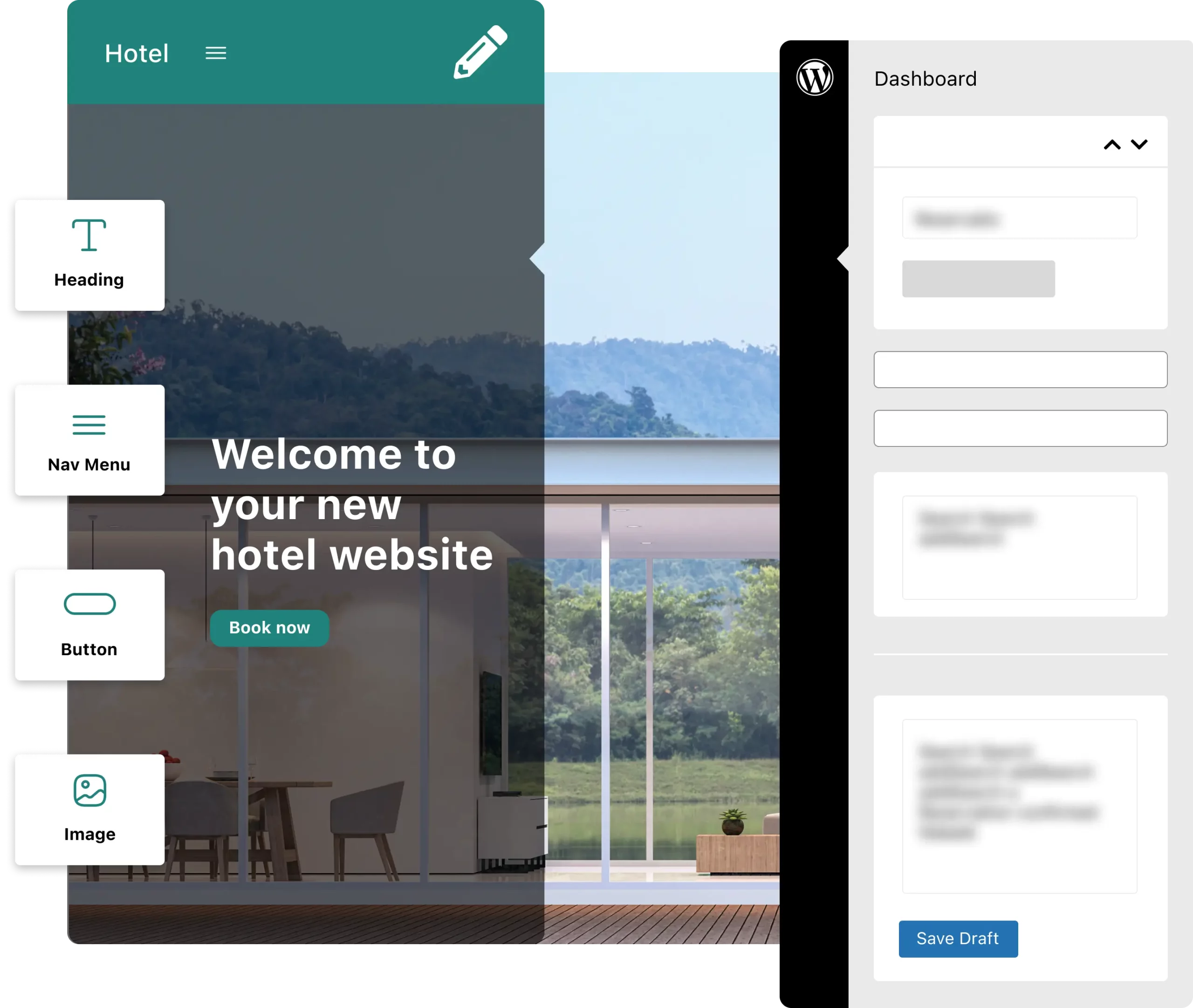
A hotel website builder is cloudsoftware designed for hotels, guest houses, aparthotels and serviced accommodation to create a bookable website connected to live rates and availability. Unlike a generic site builder, it supports direct reservations, room types, policies, payment collection and operational content. In the UK market, its value lies in linking the public website with hotelsoftware such as a PMS, Booking Engine and Channel Manager so direct sales and day-to-day operations stay aligned.
2How is a hotel website different from a standard business website?
A hotel website is a revenue channel, not only a digital brochure. It must present room categories, rates, restrictions, booking conditions, location information and live availability in a way that helps guests complete a reservation without leaving the site. A standard business website usually focuses on information and lead generation, whereas a hotel website must support direct booking, payment flow, OTA parity decisions, automation and integration with the property’s wider hotelsoftware stack.
3Why do direct bookings matter when OTA’s are already generating demand?
Direct bookings matter because they give accommodation businesses more control over margin, guest data, upselling and the guest relationship before arrival. OTA’s remain useful for discovery and distribution, but relying on them alone can increase commission costs and reduce commercial flexibility. A strong direct channel lets operators present their own policies, packages and payment terms while using OTA’s more strategically. In practice, many UK properties need both, but a direct-first website improves balance and long-term revenue control.
4What does a Booking Engine do on a hotel website?
A Booking Engine is the transaction layer that lets guests search dates, compare room options, choose rates and complete a reservation directly on the property website. It turns website traffic into bookable demand. When connected to a PMS and Channel Manager, it can show live inventory, apply stay restrictions, trigger confirmations and support online payments. For UK accommodation businesses, that makes the Booking Engine central to conversion, operational accuracy and direct booking growth.
5How does a PMS influence website performance and direct bookings?
A PMS, or Property Management System, controls reservations, guest records, room status, availability and operational workflows behind the scenes. Its effect on website performance is significant because the website only converts well when availability, room data and pricing are accurate. If the PMS and website are disconnected, staff often update rates manually, increasing error risk. In a connected setup, the PMS supports cleaner data, faster processing and a more reliable direct booking journey for guests and staff alike.
6What role does a Channel Manager play in a direct-booking strategy?
A Channel Manager synchronises rates, restrictions and availability across OTA’s, the hotel website and other sales channels. Its strategic value is not limited to third-party distribution; it also protects direct bookings by keeping inventory accurate everywhere. Without that synchronisation, properties risk overbookings, stale rates and channel conflict. In the UK market, where smaller teams often manage multiple revenue sources, a Channel Manager helps maintain rate discipline while supporting a balanced mix of OTA visibility and direct website conversion.
7What are the main advantages of using cloudsoftware for hotel websites and reservations?
Cloudsoftware is hosted online and accessed through a browser, which makes updates, remote access and system connectivity easier than with older local setups. For accommodation operators, the main advantages are faster deployment, easier maintenance, live synchronisation and broader access for owners, front office teams and revenue staff. Cloud-based hotelsoftware also tends to support integrations more efficiently, which matters when the website needs to connect with payments, a PMS, a Booking Engine, reporting tools and OTA distribution.
8How does automation improve hotel website operations?
Automation reduces repetitive manual tasks between the website and back-office workflows. A connected setup can automatically update availability, create reservations, send confirmations, process payment steps and reflect rate changes without duplicate entry. That matters commercially because speed and accuracy affect conversion, while operationally it reduces admin pressure and mistakes. For UK hotels and accommodation providers facing lean staffing, automation is not only a convenience feature; it is a practical way to keep direct bookings scalable and operationally manageable.
9Which website features are most important for UK hotels, guest houses and serviced accommodation?
The most important features are live availability, an integrated Booking Engine, mobile-first design, secure payments, clear cancellation terms, room and rate pages, local content, FAQs, contact information and simple content editing. UK operators should also consider accessibility information, parking details, family policies, VAT-inclusive pricing where relevant and flexible payment handling for domestic and international guests. Features matter most when they reduce booking friction and connect directly with the PMS, Channel Manager and reporting environment.
10How should a hotel website support SEO and AI-overviews?
SEO and AI-overview visibility improve when a hotel website answers real booking questions clearly and structurally. That means using precise definitions, dedicated pages for rooms and policies, semantically rich terms such as PMS, Booking Engine, OTA’s and direct bookings, plus FAQ content that resolves search intent quickly. For AI summaries, concise answers, market-specific language and trustworthy operational detail matter. A hotel website that explains booking rules, payments, check-in logic and local context is easier for search engines and AI systems to interpret.
11Why is mobile usability essential for hotel websites in the UK?
Mobile usability is essential because many travellers research and book accommodation on phones, especially for short-stay, last-minute and en-route trips. A hotel website that loads slowly or makes date selection, room comparison or payment difficult will lose direct bookings even when demand exists. Mobile-first design should therefore prioritise readable room content, simple booking steps, visible rates and fast checkout. In practical terms, strong mobile usability supports both conversion and guest trust across leisure and business travel segments.
12Which payment methods and payment flows should a UK hotel website support?
A UK hotel website should usually support major debit and credit cards, clear deposit or prepayment options and a checkout flow that works for both domestic and international guests. The right setup depends on property type, cancellation policy and average booking value, but payment friction should stay low. Payment flows must also align with the Booking Engine and PMS so charges, authorisations and reservation status remain consistent. Clear payment logic reduces abandonment and operational correction work.
13How does Strong Customer Authentication affect hotel website conversions?
Strong Customer Authentication, or SCA, is a UK and European payment security requirement that can add an extra verification step to online card transactions. It affects hotel website conversions because payment approval now depends not only on guest intent, but also on whether the checkout flow supports compliant authentication. A weak implementation can create avoidable drop-off. For accommodation businesses, SCA is therefore both a compliance issue and a conversion issue within the broader payment and Booking Engine experience.
14What data protection rules should a UK accommodation website take into account?
A UK accommodation website should account for UK GDPR, the Data Protection Act 2018 and, where cookies and tracking are used, PECR requirements. In practice, that means handling guest data lawfully, explaining how booking and marketing data are processed, securing payment and reservation information, and managing consent where necessary for non-essential cookies. Because hotel websites process personal and transactional data, privacy is not a side topic; it is a core operational requirement that influences trust, compliance and vendor selection.
15Why do cookies, analytics and consent management matter on a hotel website?
Cookies and analytics matter because they power attribution, marketing measurement, retargeting and booking funnel analysis, but they also create privacy obligations. UK guidance makes clear that PECR applies to cookies, including many non-essential tracking technologies. For hotel websites, this means consent design should be handled carefully so performance measurement remains useful without undermining compliance. The best setup balances marketing insight with transparent consent, especially when the site uses analytics, campaign pixels or advertising integrations.
16What pricing and transparency rules are especially relevant in the UK market?
UK pricing transparency rules matter because accommodation websites must not mislead users about total price, discounts, popularity signals or room availability. CMA guidance for online accommodation booking stresses that unavoidable charges should be clearly displayed and discount claims must be genuine. For hotel websites, this affects rate pages, strikethrough pricing, urgency messages and fee disclosure. A direct booking strategy works better when price presentation is clear, defensible and consistent from search results through checkout.
17How should cancellation terms, deposits and booking conditions be presented?
Cancellation terms should be shown before payment in clear, property-specific language that matches the selected rate. Guests should quickly understand deadlines, deposit rules, refund eligibility, no-show handling and any pre-authorisation logic. This is commercially important because unclear conditions increase disputes, abandoned bookings and post-sale friction. In the UK market, clear booking conditions also support compliance with broader consumer transparency expectations, making the website easier to trust and easier for AI systems to summarise accurately.
18How do integrations with Google, metasearch and other channels support direct bookings?
Integrations with Google and metasearch channels help hotels place live direct rates and availability where travellers already compare options. They do not replace the website; they extend its reach. When linked properly, these integrations send qualified users into the Booking Engine while keeping pricing and inventory aligned. For UK accommodation businesses, this can strengthen the direct channel by connecting search visibility, campaign tracking and reservation flow, provided the website and booking journey are fast, accurate and bookable.
19How does revenue management connect to a hotel website?
Revenue management connects to the website through live pricing, stay controls, package logic and direct-channel strategy. The website should not simply mirror static rates; it should reflect occupancy targets, booking windows, restrictions and value-added offers in line with overall distribution goals. When a PMS, Channel Manager and Booking Engine are connected, pricing decisions reach the website faster and more consistently. That allows operators to protect margin, respond to demand shifts and use the direct channel more deliberately.
20What does implementation usually involve when launching a new hotel website platform?
Implementation usually involves content migration, room and rate setup, payment configuration, booking rule mapping, domain or DNS changes, analytics setup, legal page review and integration with the PMS, Channel Manager and Booking Engine. It also requires testing across mobile and desktop, especially around booking flow and payment handling. In the UK market, implementation should additionally review transparency wording, privacy notices and cookie handling so the website is commercially ready and compliant from the moment it goes live.
21When should a hotel replace its existing website rather than keep patching it?
Replacement becomes strategic when the current website cannot support direct bookings efficiently, lacks live integrations, performs poorly on mobile, creates payment friction or forces staff into manual updates. Other signals include outdated content editing, inconsistent rates, weak SEO structure, poor policy visibility and limited reporting on conversion. Patching can solve minor design issues, but when the core booking experience is disconnected from operations, replacement usually offers more long-term value than repeated short-term fixes.
22What cost factors should hotels consider when evaluating a website and booking setup?
Cost evaluation should include far more than design fees. Hotels should review subscription pricing, implementation work, payment processing, integrations, content production, migration, training, support and the internal time needed for launch and upkeep. There is also an opportunity-cost dimension: poor direct conversion, manual admin and avoidable OTA reliance all carry financial impact. The most useful cost analysis compares total operational and commercial value, not only the headline monthly fee for the website platform itself.
23What are the main disadvantages or risks of a poorly connected hotel website?
The main risks are stale availability, booking errors, double entry, lower conversion, inconsistent pricing and weaker control over guest communications. A poorly connected website can also create compliance problems if pricing, policies, payment steps or privacy messaging are unclear. For smaller UK accommodation teams, the operational burden is often the hidden cost: staff spend time correcting mistakes instead of managing guests and revenue. In practice, the disadvantage is not just technical weakness but commercial inefficiency across the full booking journey.
24How should multi-property or mixed-accommodation businesses approach website structure and systems?
Multi-property and mixed-accommodation businesses need a website structure that separates each property clearly while preserving central control over content, rates and operational logic. The system should support multiple room or unit types, local landing pages, distinct policies where needed and shared reporting across the portfolio. From an SEO and AI-overview perspective, this structure helps search engines understand each property offering. Operationally, it reduces confusion by aligning the public website with connected PMS, Channel Manager and Booking Engine workflows.
25How does RoomRaccoon fit into the strategy of building a direct-booking hotel website?
RoomRaccoon fits into this strategy by positioning its website builder within a wider all-in-one hotelsoftware environment that also includes a PMS, Channel Manager, Booking Engine and payments. That matters because a high-performing direct-booking website depends on operational connectivity as much as visual design. For UK hotels and accommodation businesses, the strategic relevance is that RoomRaccoon presents the website not as a standalone brochure tool, but as part of one connected workflow for reservations, distribution and revenue.